

Table of Contents
- Personal Trainer Garage Gym Setup Tips: Start With a Client-Ready Plan
- Measure Floor Space and Ceiling Height Before Anything Else
- Garage Gym Layout Ideas for One-on-One and Small Group Sessions
- Garage Gym Equipment Checklist for Training Clients
- Home Gym Flooring for Weights That Handles Daily Client Traffic
- Garage Gym Safety Tips for Training Paying Clients
- Climate, Ventilation, and Noise: What Competitors Skip
- Conclusion: Build the Space Your Clients Keep Coming Back To
- Frequently Asked Questions
Last Updated: October 16, 2026
Personal Trainer Garage Gym Setup Tips: Start With a Client-Ready Plan
A personal trainer garage gym setup tips guide starts with one hard truth: your garage is a commercial space the moment a client pays you to train in it.
So before you buy a single weight plate, answer three questions:
- How many clients train at once, and how do they move through the space?
- What are your training goals for those clients: strength, conditioning, or both?
- What does your garage actually allow, in floor space and ceiling height?
Get those answers on paper and the rest of your garage gym setup gets much easier. Skip them and you will buy equipment that does not fit, in a layout that does not work.
Measure Floor Space and Ceiling Height Before Anything Else
Floor space and ceiling height decide what equipment you can buy. Measure both before you spend a dollar. A typical two-car garage gives you roughly 20 feet by 20 feet of usable floor, but parked cars, water heaters, and steps eat into that fast.
Here is what to measure and why it matters:
- Ceiling height: You need at least 9 feet of clearance for a power rack with a pull-up bar. Standard 8-foot ceilings rule out most full racks.
- Usable floor: Subtract anything you cannot move, including the water heater platform and the garage door tracks.
- Door swing: Overhead doors need clearance above. Check how far the door travels when open.
Write the numbers down. Every layout decision after this depends on them.
Garage Gym Layout Ideas for One-on-One and Small Group Sessions
A good garage gym layout keeps clients moving in one direction. One-on-one sessions need a single lifting zone plus open floor; groups of four to five need separate workout zones so nobody waits.
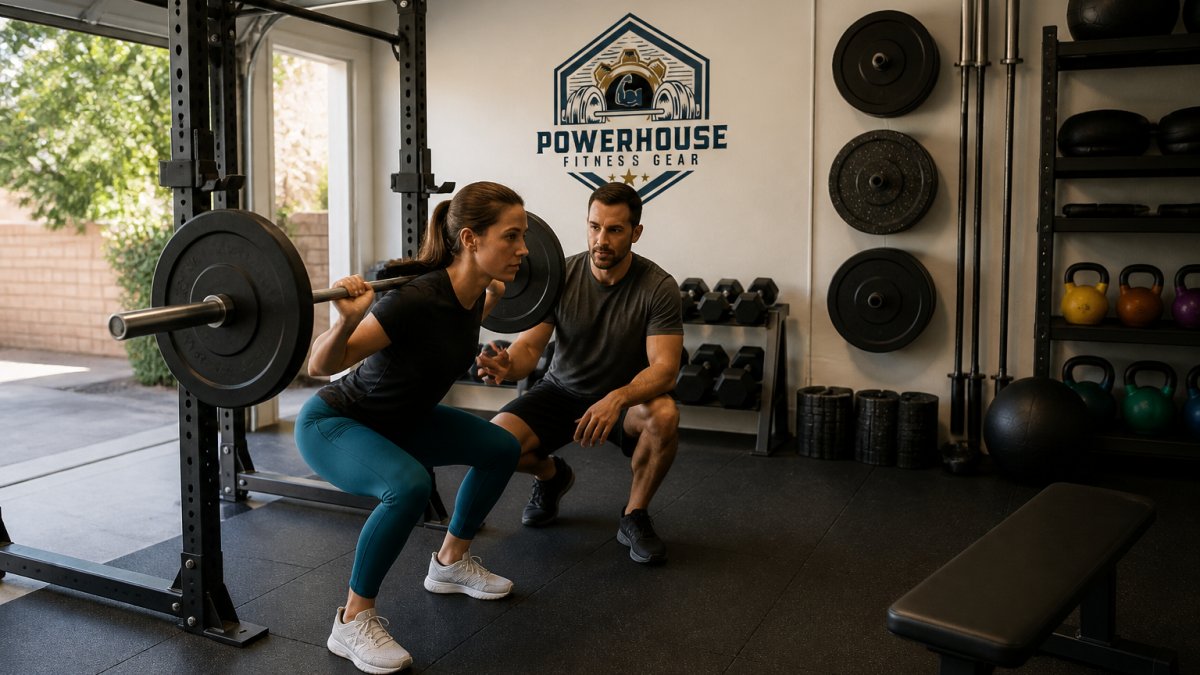
Try these garage gym layout ideas based on how you coach:
- The single-zone layout: One power rack, one bench, and open floor for one client at a time.
- The circuit layout: Three to four stations arranged in a loop for group conditioning.
- The split layout: Strength on one side, cardio and mobility on the other.
Leave at least 3 feet of clearance around any bar you load, and for a group of five, plan for roughly 100 square feet per person in the strength zone.
Garage Gym Equipment Checklist for Training Clients
A client-ready garage gym equipment checklist covers five categories: strength, cardio, accessories, storage, and the small operational items that keep sessions running. Buy in that order; strength equipment earns its place first, but the last category is what separates a home gym from a professional training space.
Start with these essentials:
- Power rack or squat rack: The anchor of any strength setup. Look for a rack rated for daily use, with a pull-up bar and J-cups that fit your bar diameter. A 3x3-inch 11-gauge steel rack is the common commercial benchmark; thinner 14- or 16-gauge steel flexes under repeated loaded squats.
- Olympic barbell and weight plates: One quality bar beats three cheap ones. A 20 kg (about 44 lb) men's bar with a 28-29 mm shaft and a 190,000+ PSI tensile rating handles daily client use. Bumper plates protect your floor and let beginners bail safely.
- Adjustable bench: Flat-to-incline coverage in one footprint. Check the pad width and the gap between pad and seat; a wide gap pinches clients during dumbbell presses.
Durability matters more than variety here. Commercial-rated gear from trusted manufacturers costs more up front, but it survives daily client traffic.
How equipment choices change when clients train with you
A home gym serves one person; a client-ready garage gym serves a rotating cast, which changes what you buy:
- Adjustability beats specificity. One adjustable bench and one adjustable dumbbell set serve more clients than a fixed bench and a rack of singles, because clients arrive at different heights, limb lengths, and strength levels.
- Duplicate the bottlenecks. If every session starts with a barbell warm-up, one bar creates a queue. A second bar and a second set of collars cost far less than lost session time.
- Buy for the transition, not just the lift. A plate tree within arm's reach of the rack, a bench you can slide rather than carry, and a band rack at chest height all cut the dead time between sets.
Home Gym Flooring for Weights That Handles Daily Client Traffic
Home gym flooring for weights needs to protect your concrete, your plates, and your clients' joints. Rubber is the answer for almost every garage setup.
Your main options:
- Rubber stall mats: Thick, cheap per square foot, and easy to find. Great for most garages.
- Interlocking rubber tiles: Cleaner look, easier install, higher cost.
- Lifting platform: Plywood plus rubber for Olympic lifts and heavy deadlifts.
For daily client traffic, go thicker. A ¾-inch rubber surface handles dropped dumbbells and loaded bars without cracking. Check the CDC guidance on home exercise safety for general injury-prevention principles that apply to any training space.
Garage Gym Safety Tips for Training Paying Clients
Garage gym safety tips matter more when clients pay you, because you carry the responsibility. Safety starts with the space, not the equipment.
Cover these basics:
- Anchor your racks. Bolt power racks to the floor or wall. A tipping rack is the worst-case scenario.
- Keep walkways clear. Clients should never step over plates or bands.
- Store plates low. Heavy plates go on bottom pegs to prevent back injuries during setup.
If you run a home business, check your local rules on permits and insurance before you take your first paying client. Requirements vary by state and city, so confirm what applies to you. The U.S. Small Business Administration outlines general home-business and licensing considerations worth reviewing early.
Climate, Ventilation, and Noise: What Competitors Skip
Most garage gym guides ignore the three things that decide whether clients actually enjoy training with you: climate, air, and sound. Garages get hot in summer, cold in winter, and stuffy year-round. Fix that and clients stay.
Climate: keep the space in a trainable range
A garage is a poorly insulated box with a large metal door, so it swings with the outside temperature faster than any room in the house. The goal is keeping clients safe and willing to come back.
- Heat: Above roughly 80°F, clients fatigue faster, grip fails sooner, and heavy lifts get riskier. A mini-split sized for the square footage is the most reliable fix. A heavy-duty fan moves air but does not lower temperature, so it helps most when humidity is low.
- Cold: Below roughly 50°F, clients need longer warm-ups and their hands and joints feel stiff. A garage-rated space heater plus a proper warm-up protocol covers most winter sessions. Never run a fuel-burning heater in a closed garage; carbon monoxide is a real risk.
- Insulation: An insulated garage door and insulated walls slow the temperature swing and cut the load on whatever heating or cooling you add. This is the highest-return upgrade most trainers skip.
Ventilation and moisture: protect clients and equipment
Conditioning work in a closed garage raises humidity fast, and humidity rusts your plates, racks, and barbell knurling.
- Air movement: An exhaust fan or a window with a box fan pulls humid air out. Run it during and after conditioning blocks, not just before.
- Moisture control: A dehumidifier keeps relative humidity in check. Aim to keep the space dry enough that bare steel does not flash-rust; if you see rust on plate hubs or bar shafts, humidity is too high.
- Condensation: Cold concrete plus warm humid air equals condensation on floors and equipment. That is a slip hazard for clients and a rust source for gear. Insulating the door and running the dehumidifier addresses both.
Noise: respect the household and the neighbors
A garage shares walls with the house and often faces a neighbor's window. Sound is a professional courtesy issue as much as a comfort one.
- Absorb the echo: Rubber flooring and wall panels cut the hard-surface echo that makes a garage sound louder than it is. A dropped bumper plate on bare concrete is dramatically louder than the same drop on ¾-inch rubber.
- Control the source: Set music at a level you can talk over. If you have to raise your voice to coach, the music is too loud for the space and the neighbors.
- Time your loud work: Olympic lifts and heavy deadlifts are the loudest part of any session. If you train early or late, schedule those blocks accordingly or add a lifting platform to damp the impact.
Lighting and accessibility: the details that make it feel professional
Bright LED shop lights make the space feel professional and keep clients safe during heavy lifts. Aim for even, shadow-free light over every station. To serve clients with mobility needs, leave clear paths at least 36 inches wide, add a stable bench for seated work, and keep the most-used equipment at reachable heights.
Conclusion: Build the Space Your Clients Keep Coming Back To
Turning a garage into a client-ready training space takes planning, not a big budget. Measure first, lay out for flow, buy durable equipment, and fix the climate and noise issues most trainers overlook.
Powerhouse Fitness Gear helps trainers get there with premium strength and cardio equipment selected from trusted manufacturers. Our gear is built for daily use, with the craftsmanship and reliability that hold up to paying clients year after year.
Frequently Asked Questions
How much space do you need for a personal trainer garage gym?
A standard two-car garage gives most trainers enough room to work with one or two clients at a time. Plan for roughly 100 to 150 square feet of open training area, plus clearance around a power rack and bench. Leave at least 3 feet on each side of a barbell and 2 feet behind a bench press station. If you train small groups, a one-car garage will feel tight once you add cardio equipment and storage, so prioritize vertical storage and foldable gear.
What equipment does a personal trainer need in a garage gym?
Start with a power rack or squat rack, an Olympic barbell, weight plates, and an adjustable bench. Add dumbbells, kettlebells, and resistance bands for variety, plus a cable machine if space allows. For client sessions, include a lifting platform or stall mats, weight storage, and a whiteboard for programming. A garage gym equipment checklist should also cover cardio equipment like a rower or bike, and small items such as collars, clips, and a foam roller.
What is the best flooring for a garage gym with heavy weights?
Rubber flooring is the standard choice for home gym flooring for weights. Interlocking rubber tiles or rolled rubber in 8mm to 12mm thickness handle dropped dumbbells and daily foot traffic. Stall mats, usually 4 feet by 6 feet, work well under racks and deadlift areas. For Olympic lifting, build a lifting platform with plywood and rubber on top. Avoid bare concrete, which cracks under impact and is slippery when sweaty.
How can you make a garage gym safe for clients?
Secure the space before clients arrive. Anchor racks and storage to the floor or wall, keep walkways clear of plates and bands, and check that electrical outlets are GFCI-protected. Store plates on a tree or wall rack, not on the floor. Add lighting that reaches every corner, and keep a first aid kit and fire extinguisher within reach. Review your homeowner's insurance policy for business use, and confirm local permits if clients visit regularly.


