

Table of Contents
- Quick Comparison: Best Heavy Duty Home Gym Flooring Options
- Rubber Gym Floor Tiles vs Rolls: Which Wins for Heavy Lifting?
- Best Thickness for Deadlifting Platforms and Heavy Racks
- Weight Capacity Per Square Foot: The Spec Most Buyers Miss
- How to Install Home Gym Flooring Over Concrete and Wood
- Off-Gassing, VOCs, and What 'Non-Porous' Actually Means
- Which Heavy Duty Gym Flooring Fits Your Setup?
- Frequently Asked Questions
Last Updated: September 30, 2026
Quick Comparison: Best Heavy Duty Home Gym Flooring Options
Finding the best heavy duty home gym flooring starts with matching material to the load your rack, platform, and dumbbells will place on it. Buyers who choose by thickness alone often end up replacing floors within a year or two. The right pick depends on density, subfloor, and how you train.
|
Option |
Best For |
Key Strength |
Watch Out For |
|---|---|---|---|
|
Rubber rolls |
Large spaces, wall-to-wall coverage |
Few seams, fast install |
Heavy to move solo |
|
Interlocking tiles |
Garages, rental spaces |
Easy DIY layout, replaceable |
Seams can shift under load |
|
Stall mats |
Deadlift platforms, budget builds |
High density, low cost |
Strong odor when new |
|
Specialty gym matting |
Mixed cardio and lifting |
Shock absorption, anti-fatigue |
Higher cost per square foot |
Rubber Gym Floor Tiles vs Rolls: Which Wins for Heavy Lifting?
The best heavy duty home gym flooring for heavy lifting is usually a rubber roll, because fewer seams mean fewer failure points under a loaded barbell. Tiles win when you need flexibility, replaceable sections, or a rental-friendly install. But the decision should hinge on three measurable factors: seam count, roll width, and how the material behaves under a point load.
Rolls: Fewer Seams, More Mass
Rolls ship in widths that typically range from about 4 feet to 6.5 feet, with 4-foot-wide, 25- to 50-foot-long rolls being the most common configuration for home gyms. A 4-foot by 25-foot roll covers 100 square feet in a single pass. Because the surface is continuous, a dropped barbell never lands on a seam, which is where most flooring failures begin.
Tiles: Modular, Replaceable, Seam-Heavy
Interlocking tiles are commonly sold in 24-inch by 24-inch or 39-inch by 39-inch squares, with a 0.375- to 0.5-inch thickness for general lifting and 0.75-inch for platform use. A 24-inch tile covers 4 square feet, so a 400-square-foot garage needs roughly 100 tiles.
The Decision Framework
- Permanent, wall-to-wall coverage in a dedicated room: rolls. Fewer seams, cleaner look, better long-term performance under a fixed rack.
- Garages, basements, rentals, or reconfigurable spaces: interlocking tiles. You can pull them up, replace sections, and move them.
- A dedicated deadlift or Olympic platform: neither alone. Build the platform from 0.75-inch rubber plus a plywood core, then surround it with rolls or tiles for the rest of the floor.
- Mixed cardio and lifting: tiles for the lifting zone, thinner anti-fatigue matting for the cardio zone.
What to Ask Before You Buy
Ask the supplier for the roll width, the tile dimensions, the durometer (hardness) of the rubber, and the compression set. A durometer in the 60 to 70 Shore A range is typical for high-density gym rubber. If a listing does not publish those numbers, treat the product as unverified and request a sample.
Best Thickness for Deadlifting Platforms and Heavy Racks
The best thickness for deadlifting platforms is 0.75 inches (about 19 mm) of high-density rubber, often paired with a plywood core. Anything thinner compresses under repeated drops and transfers shock into your subfloor.
Weight Capacity Per Square Foot: The Spec Most Buyers Miss
Weight capacity per square foot tells you how much load a floor can take before it deforms, and it's the number most listings bury. A floor rated for light cardio will dent under a loaded power rack.
Compression Set and Why It Determines Floor Lifespan
Compression set is the permanent dent left after a load is removed. Low compression set means the floor springs back; high compression set means it stays flattened. This single property decides whether your floor still looks and performs well in five years.
How to Install Home Gym Flooring Over Concrete and Wood
Installing over concrete or wood follows the same core sequence: prep, protect, lay, and secure. The subfloor decides the details.
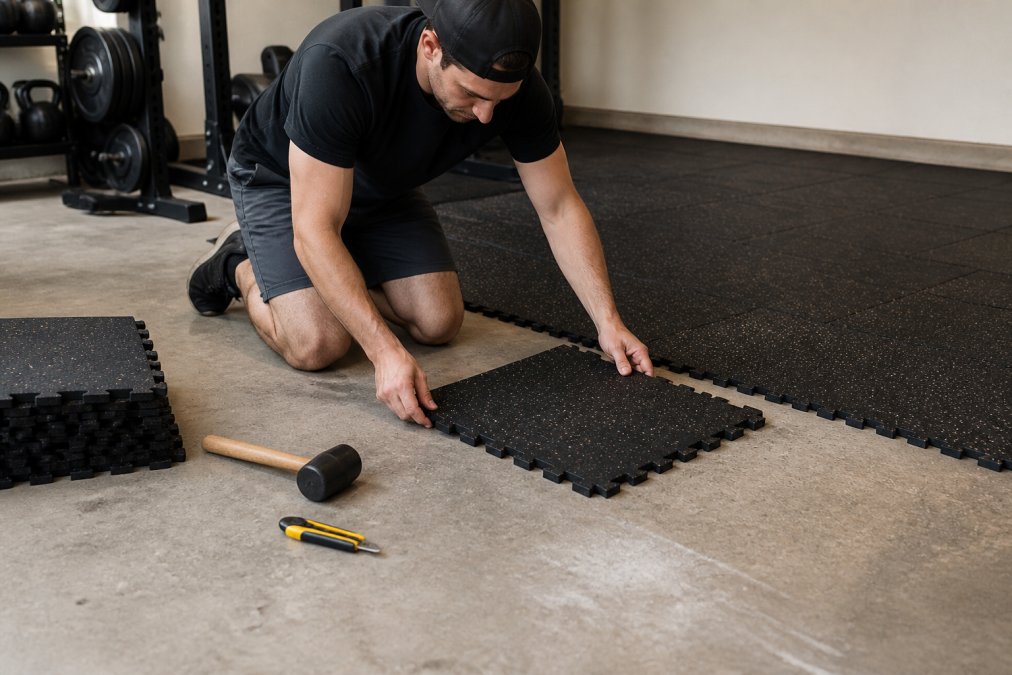
- Clean and level the subfloor. Sweep concrete, fill cracks, and check for moisture. Wood floors need a flat, sound surface.
- Lay a moisture barrier. A plastic vapor barrier stops concrete moisture from reaching rubber.
- Acclimate the flooring. Let rubber sit in the room for a day so it settles.
- Dry-fit the layout. Arrange tiles or unroll sheets before committing.
- Cut to fit. Trim edges with a utility knife around walls and posts.
- Secure seams. Use adhesive or seam tape on rolls; interlocking tiles snap together.
Subfloor Protection and Moisture Barriers
Subfloor protection is the layer that keeps moisture and impact away from the structure beneath your gym. Concrete wicks moisture that traps under rubber and breeds odor; wood flexes and can creak under load.
Off-Gassing, VOCs, and What 'Non-Porous' Actually Means
New rubber flooring often off-gasses, releasing volatile organic compounds (VOCs) that cause that strong tire smell. Recycled rubber tends to smell more at first; quality vulcanized rubber settles faster with ventilation. But off-gassing is only half the story. The other half is whether the flooring is safe for your specific subfloor and how much load it can carry before it deforms.
Subfloor Compatibility: Concrete, Wood, and Carpet
Most buying guides ignore this, and it is the number one source of failed home gym floors.
- Concrete: The most common gym subfloor, and the most forgiving for load. Concrete handles point loads from racks and platforms well, but it wicks moisture. A plastic vapor barrier (6-mil or thicker) under the rubber stops that moisture from trapping and breeding odor. Check for moisture with a plastic-sheet test: tape a 2-foot square of plastic to the slab for 24 hours and look for condensation underneath.
- Wood: Wood flexes under load, which is bad for a heavy rack. Add a plywood underlayment (typically 0.5- to 0.75-inch) to spread point loads before laying rubber. Skip this and a loaded power rack can dent the wood or cause squeaks and movement.
- Carpet: Carpet is the worst subfloor for heavy lifting. It compresses unevenly, holds moisture, and lets rubber tiles shift. If you must lay over carpet, use a rigid underlayment panel first, or accept that the floor will feel soft and seams will move.
- Existing tile or vinyl: Generally fine as a flat surface, but check for height transitions and loose tiles before laying rubber over them.
Weight Capacity Per Square Foot: The Spec Most Buyers Miss
Weight capacity per square foot tells you how much load a floor can take before it deforms, and it is the number most listings bury. A floor rated for light cardio will dent under a loaded power rack.
Compression Set and Why It Determines Floor Lifespan
Compression set is the permanent dent left after a load is removed. Low compression set means the floor springs back; high compression set means it stays flattened. This single property decides whether your floor still looks and performs well in five years.
Reducing Off-Gassing and VOCs
Non-porous means liquid and sweat cannot soak into the surface. That is why non-porous rubber cleans easily and resists bacteria in a home workout space. Porous foam-backed mats absorb sweat and degrade faster.
Maintenance and Longevity
Rubber flooring is low-maintenance but not maintenance-free. Sweep or vacuum grit regularly, because grit acts like sandpaper under foot traffic and equipment. Mop with a pH-neutral cleaner, not a solvent or citrus degreaser, which can break down rubber over time. Dry the surface after mopping to prevent moisture from sitting in seams, where mold can start. In humid basements, run a dehumidifier to keep the space below roughly 50 percent relative humidity.
Which Heavy Duty Gym Flooring Fits Your Setup?
- Garage powerlifter: 0.75-inch platform plus rubber tiles around it
- Boutique studio: wall-to-wall rolls for a clean, seamless look
- Small home space: interlocking tiles you can lift and rearrange
- Mixed cardio and lifting: layered matting with anti-fatigue zones
At Powerhouse Fitness Gear, we select strength and cardio equipment built for long-term reliability, and we help customers plan floors that hold up to real training loads. Pairing the right flooring with durable gear is how a home gym keeps performing for years.
Frequently Asked Questions
What is the best permanent flooring for a home gym?
Vulcanized rubber in tile or roll form is the most durable permanent option for a home gym. High-density rubber handles dropped barbells, resists compression set, and stays slip-resistant even when chalk or sweat builds up. Tiles work well for wall-to-wall coverage because you can replace a single damaged piece; rolls suit deadlift platforms and open lifting zones where seams create trip points. Match thickness to your heaviest load and confirm the subfloor is level before installing anything permanent.
How thick should my home gym flooring be?
For general cardio and dumbbell work, 8 mm rubber is enough. For Olympic lifting and dropped barbells, 19 mm to 25 mm is the practical range, and deadlift platforms typically use 19 mm rubber over a plywood base. Anything past 25 mm adds cost and height without meaningful shock absorption gains. The deciding factor is the weight you drop and how often, not the room size.
Can mold grow under rubber flooring?
Yes, if moisture gets trapped between the rubber and a concrete slab. Rubber itself resists mold, but condensation wicking up through concrete has nowhere to go once covered. Install a moisture barrier or vapor barrier first, seal seams on roll flooring, and avoid washing the floor with standing water. If you notice a musty smell or lifting edges, pull the affected tiles and check the slab before reinstalling.
Is 3/4 inch rubber flooring necessary for home gyms?
Rarely. Three-quarter inch rubber is commercial-grade and usually overkill for a home setup. Most home lifters get full protection from 19 mm (roughly 3/4 inch) only in the deadlift zone, paired with thinner tiles elsewhere. If you are dropping 400+ lb from overhead regularly, thicker rubber over a plywood base makes sense. For everything else, spend the difference on a proper platform instead.
Choosing the wrong floor is expensive to undo, and it's the mistake we see most often in home gym builds. Powerhouse Fitness Gear carries premium equipment selected from trusted manufacturers, built with superior craftsmanship for durability and long-lasting reliability, so your space performs as hard as you train. Get started with Powerhouse Fitness Gear and build a home gym floor and setup designed to last.


