

Table of Contents
- How to Choose the Best Gym Equipment for Small Studios
- Essential Small Gym Equipment for Strength Training
- Best Cardio Equipment for Small Gyms
- Gym Equipment Layout for Small Spaces
- Commercial Gym Flooring for Small Studios
- Budget Tiers and Total Cost of Ownership
- Conclusion
- Frequently Asked Questions
Last Updated: October 7, 2026
How to Choose the Best Gym Equipment for Small Studios
Choosing the best gym equipment for small studios comes down to three filters: floor space, commercial durability, and total budget.
Most studio owners start with the wrong question.
A common mistake is buying home-grade gear for a commercial space. It saves money up front and costs more within a year, because residential equipment is not built for eight classes a day.
Below, we break down the best gym equipment for small studios by category, with the quantities, layout math, and budget tiers that most guides skip.
Space, Durability, and Budget: The Three Filters
Space is the first filter. Measure usable floor area, not total square footage. Subtract walkways, the front desk, storage, and any required clearance around doors and electrical panels.
Durability is the second filter. Home equipment is rated for a few users a day. Studio equipment is built for continuous use, with heavier frames, better bearings, and replaceable wear parts.
Budget is the third filter, and the one owners most often underplan. The purchase price is only part of the cost.
Essential Small Gym Equipment for Strength Training
Strength equipment is where small studios get the most value per square foot. Free weights and adjustable pieces cover dozens of exercises, which means one purchase serves many class formats.
Adjustable Dumbbells, Kettlebells, and Free Weights
Adjustable dumbbells replace an entire rack of fixed weights in the space of a single pair. For a small studio, that trade is usually worth it. One set covers light warm-up work and heavy pressing without a wall of metal.
Kettlebells earn their place in any studio running functional training or small-group classes. Buy them in pairs across a range of weights, and store them on a two-tier rack to keep the floor clear.
Fixed dumbbells still make sense if your members train heavy and you have the wall space. A short run of 5 to 50 pounds covers most group programming.
- Adjustable dumbbells: one pair replaces 10 to 15 fixed pairs
- Kettlebells: buy pairs from light to heavy, store vertically
- Barbells and plates: one or two bars per rack is enough for most studios
- Weight storage: racks and trees keep walkways clear and reduce trip hazards
Compact Racks and Functional Trainers
A functional trainer is the single most space-efficient strength machine a small studio can own. One unit delivers cable work for the entire body, from chest presses to rows to rotational training.
Squat racks and power racks come in compact and folding versions built for tight rooms.
For studios that want maximum versatility from one footprint, a multi-station or all-in-one gym system combines a rack, pulley system, and pull-up station. The trade-off is cost and assembly time, not floor space.
| Equipment | Footprint | Best For | Studio Priority |
|---|---|---|---|
| Adjustable dumbbells | Small | Full-body strength | Buy first |
| Kettlebells | Small | Functional training | Buy first |
| Functional trainer | Medium | Cable and rotational work | High |
| Folding squat rack | Medium | Heavy lifting, tight rooms | High |
| Multi-station system | Medium to large | All-in-one versatility | Optional |
Best Cardio Equipment for Small Gyms
The best cardio equipment for small gyms is the equipment that folds, stacks, or rolls out of the way.
Rowing machines are the standout pick for small spaces. They store upright against a wall, deliver a full-body workout, and hold up well under class use.
Foldable treadmills and walking pads solve the treadmill problem.
Wall-mounted trainers and compact cable cardio units add pulling and resistance work in almost no floor area. For studios short on space, these often replace a second machine entirely.
- Rowing machines: store upright, full-body, class-friendly
- Foldable treadmills: full cardio capability, storable deck
- Walking pads: warm-ups and recovery, minimal footprint
- Wall-mounted trainers: resistance work with near-zero floor cost
Gym Equipment Layout for Small Spaces
Gym equipment layout for small spaces works best when you zone the room by function, keep a clear center lane, and size your equipment counts to your peak class size rather than your total membership. Most guides stop at "put racks on the wall." The layout math below is what actually determines whether a class runs smoothly or bottlenecks at the dumbbell rack.
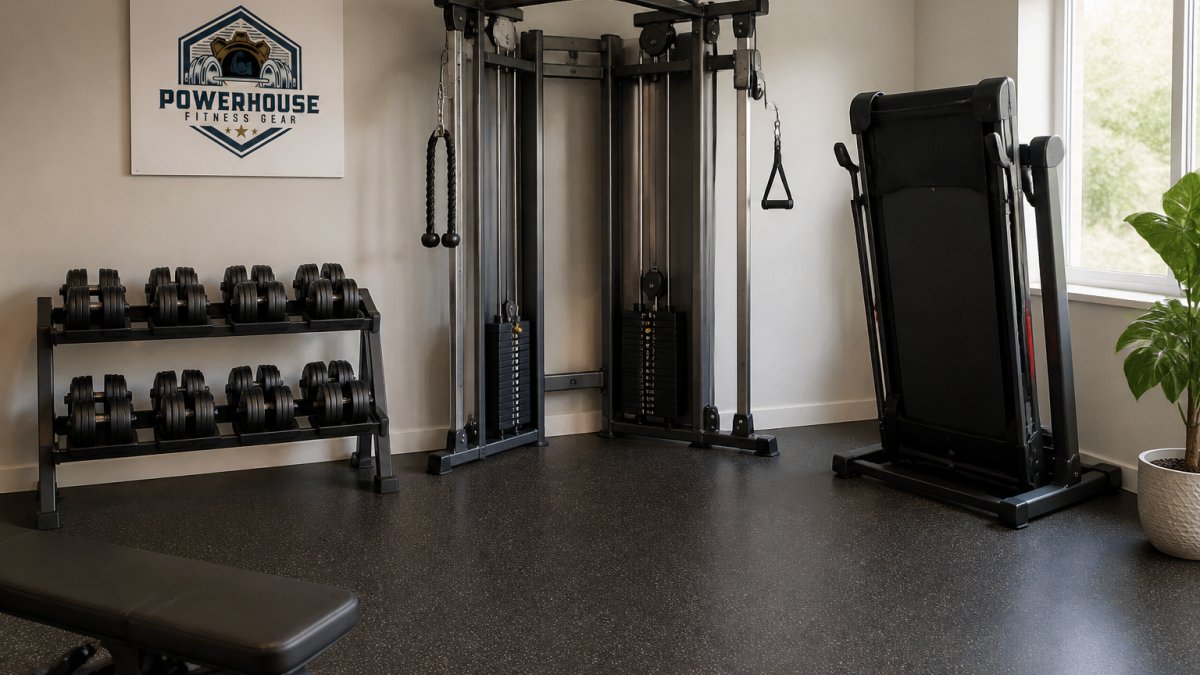
Start with usable floor, not total square footage
Measure the room, then subtract everything you cannot train on: walkways, the front desk, storage, restrooms, and the clearance required around doors and electrical panels. What remains is usable floor.
A common planning range among studio operators is 35 to 50 square feet of open floor per person in a small-group strength class, plus dedicated zones for racks and cardio. This figure covers the person, their equipment, and enough room to move between stations without colliding with a neighbor.
Size equipment counts to peak class size
This is the step most equipment lists skip. Match your unit counts to the largest class you plan to run, not your average class.
- Strength circuits (6 people): 6 stations. One functional trainer can serve two people at once if it has dual weight stacks, so 3 trainers cover 6 members. Add 6 sets of adjustable dumbbells or 6 pairs of kettlebells so no one waits.
- Strength circuits (12 people): 12 stations. Two dual-stack functional trainers plus 6 to 8 pairs of adjustable dumbbells and a kettlebell range. Expect to add a second folding rack so two members can lift heavy at the same time.
- HIIT and conditioning (10 to 16 people): open floor plus portable equipment. Resistance bands, medicine balls, and a rower per two participants usually suffice, because HIIT rotates stations rather than holding them.
- Semi-private coaching (2 to 4 people): one functional trainer, one rack, and a full dumbbell run. This format needs the least equipment per member but the most floor per station.
The bottleneck almost always appears at the most popular station. If your programming leans on dumbbells, buy more dumbbell sets than the math suggests. If it leans on cables, add a second functional trainer before you add cardio.
A workable plan for a 600-square-foot training floor
- One wall: one dual-stack functional trainer plus one folding rack
- Opposite wall: adjustable dumbbell pairs and a kettlebell rack, sized to peak class size
- Corner: one foldable treadmill and one rowing machine stored upright
- Center: open floor for classes, kept clear between sessions
Leave at least 36 inches of walkway between zones, and more where members carry weights. Anything tighter turns a busy class into an obstacle course, and it is the single most common layout mistake in small studios.
Commercial Gym Flooring for Small Studios
Commercial gym flooring for small studios protects both your equipment and your members. Rubber tile or rolled rubber is the standard choice, and for good reason.
Rubber absorbs impact from dropped weights, dampens noise between classes, and grips underfoot during fast movements.
Thickness depends on use. Lighter areas can use thinner tile. Platforms and free-weight zones need thicker, denser rubber to handle dropped barbells without cracking the slab underneath.
Installation matters as much as the material. Seams should be tight, edges secured, and the surface level. Loose flooring is a trip hazard and a maintenance problem.
- Rubber tiles: easy to replace damaged sections
- Rolled rubber: fewer seams, faster install in large rooms
- Platforms: dedicated zones for heavy lifting
- Interlocking tiles: good for temporary or leased spaces
Budget Tiers and Total Cost of Ownership
Studio equipment budgets fall into three rough tiers, and the right tier depends on class size, class formats, and how fast you plan to grow. Most guides list product prices and stop there. What follows is a tier framework plus the ongoing costs that decide whether a studio build-out stays affordable over five years.
What each tier typically includes
Starter tier, small-group strength and conditioning for up to 6 clients. Adjustable dumbbells, a kettlebell range, one folding rack, resistance bands, and one rower or foldable cardio unit.
Mid tier, several class types a day for 8 to 12 clients. Adds a dual-stack functional trainer, a second cardio machine, proper storage racks, and commercial rubber flooring.
Full tier, larger groups or expansion plans. Adds a multi-station system, dedicated cardio, and platform flooring for heavy lifting. It suits studios training 12 or more members at once or those planning a second location.
Line items owners forget to budget
The purchase price is only part of the cost. Build these into your number from day one:
- Delivery and assembly: heavy racks and multi-station systems often ship freight and require assembly, sometimes by a technician.
- Flooring: rubber tile or rolled rubber across the full training floor, plus thicker platform material under free-weight zones.
- Storage: racks, trees, and wall mounts that keep walkways clear.
- Maintenance reserve: cables, pads, and bearings wear out on commercial equipment and need periodic replacement.
- Insurance and liability review: confirm your policy covers commercial use of the equipment you buy.
Total cost of ownership over five years
Commercial-grade equipment usually costs more up front and less over its life. Home-grade gear is cheaper to buy and more expensive to own, because it fails under daily class use and replacement cycles arrive faster. A common pattern is that a studio replaces home-grade cable machines and benches within the first year or two, wiping out the initial savings.
When you compare options, ask three questions: What is the warranty term and does it cover commercial use? How are replacement parts handled, and how fast can they ship? What is the expected service interval for cables, pads, and bearings?
For current pricing on our strength and cardio lines, check our website or request a quote.
Conclusion
Outfitting a small studio is a puzzle where every square foot has to earn its place. The owners who get it right start with class size, choose commercial-grade gear that survives daily use, and plan the layout before the first delivery arrives. Powerhouse Fitness Gear supplies premium strength and cardio equipment selected from trusted manufacturers, built for durability and long-lasting reliability, so your studio performs for years rather than seasons. Get started with Powerhouse Fitness Gear and build a training space your members return to.
Frequently Asked Questions
What equipment does a small fitness studio need?
A small studio needs adjustable dumbbells, a compact functional trainer or cable system, an adjustable bench, resistance bands, and at least one cardio machine like a rower or foldable treadmill. For small-group classes, add kettlebells in pairs and a multi-station rack. Powerhouse Fitness Gear carries studio-grade versions of each, built for daily use rather than occasional home workouts.
How much space do you need for a small fitness studio?
Plan for at least 1,000 to 1,500 square feet for a boutique studio serving 6 to 10 clients per session. Strength zones need roughly 100 square feet per person for safe lifting, while cardio machines need about 30 square feet each including clearance. Measure usable floor space after accounting for storage, entryways, and restrooms before selecting equipment.
Are adjustable dumbbells suitable for a commercial studio?
Yes, if you choose commercial-rated models with metal mechanisms rather than plastic. Commercial adjustable dumbbells handle hundreds of daily adjustments and drop resistance that home versions cannot. They save significant floor space compared to full dumbbell sets, making them ideal for small studios with limited storage.
What flooring is best for a small gym studio?
Rubber interlocking tiles or rolled rubber are the standard for small studios. Tiles of 8mm to 12mm thickness work for general training, while 15mm or thicker is needed under free weights and racks. Commercial-grade rubber handles dropped weights, reduces noise, and protects your subfloor, which matters in leased spaces.


