

Table of Contents
- Why Preventative Maintenance Matters for Commercial Gym Equipment
- Daily Cleaning and Disinfection for Gym Equipment
- Weekly Inspection and Lubrication Checklist
- Monthly Maintenance Schedule for Gym Equipment
- Treadmill Maintenance for Gyms: Deck and Motor Care
- Creating a Commercial Gym Equipment Maintenance Checklist
- Budgeting, Warranty Management, and Staff Training
- Conclusion
- Frequently Asked Questions
Last Updated: October 9, 2026
Why Preventative Maintenance Matters for Commercial Gym Equipment
The key to keeping your facility running smoothly is to maintain commercial gym equipment with a preventative approach, the difference between equipment that performs reliably for years and machinery that fails without warning.
Most gym owners skip maintenance until something breaks. That's reactive.
At Powerhouse Fitness Gear, we work with studio owners and trainers who understand that premium equipment demands premium care. Neglecting maintenance erodes your investment; a structured plan preserves it.
Equipment that receives regular attention performs better, lasts longer, and keeps your members safe. The time you invest now saves money and prevents liability issues.
Daily Cleaning and Disinfection for Gym Equipment
Daily cleaning removes sweat, bacteria, and dirt that accelerate corrosion and degradation. Clean equipment also signals professionalism and care.
Start with the surfaces members touch most: grips, seats, and armrests. Use disinfectant wipes or spray cleaner on upholstery and vinyl, wiping all contact points thoroughly.
For cardio equipment, pay special attention to the deck and belt.
Keep these supplies on hand:
- Disinfectant wipes or spray cleaner (alcohol-free to protect upholstery)
- Microfiber cloths for drying
- Soft brushes for crevices
- Vinyl cleaner for upholstered surfaces
Assign cleaning to staff at the start and end of each operating day. This takes 15-30 minutes depending on machine count.
Weekly Inspection and Lubrication Checklist
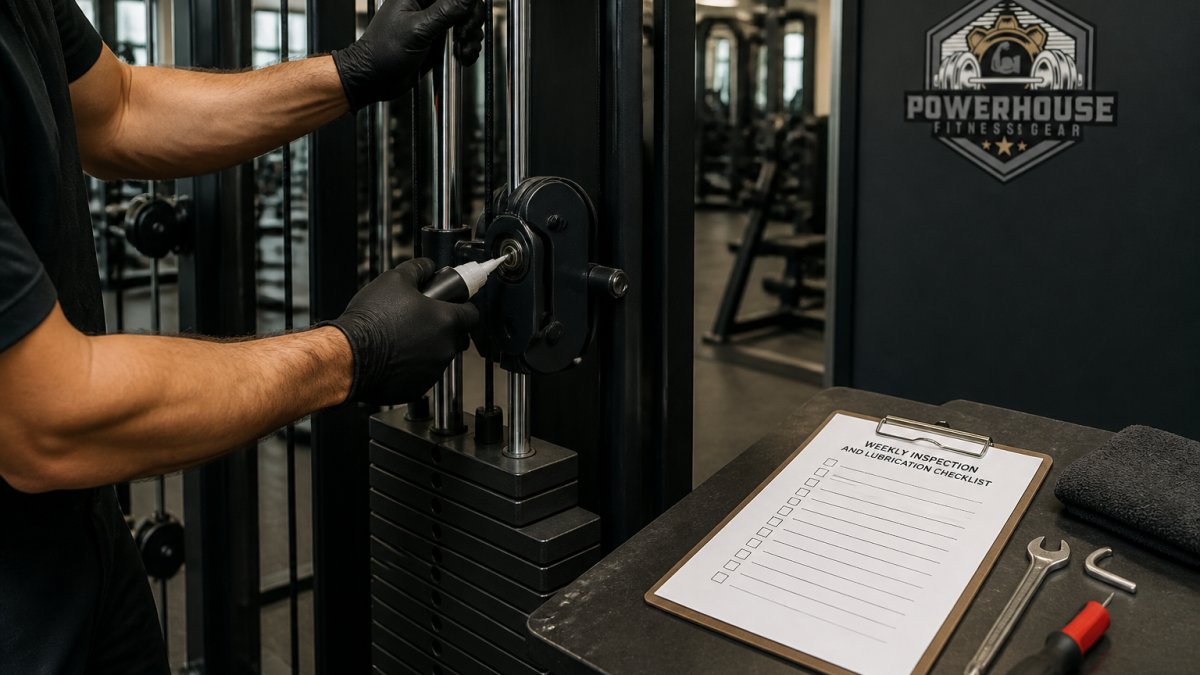
Weekly inspections catch problems early: visible damage, loose hardware, and signs of wear.
Check these items every week:
- Cables and pulleys: Look for fraying, rust, or damage. Cables under tension can snap without warning. Pulleys should rotate freely without grinding sounds.
- Guide rods: Wipe them clean and inspect for corrosion. Dirty guide rods increase friction and reduce smooth movement.
- Hardware: Tighten any bolts, screws, or fasteners that have loosened. Vibration from use naturally loosens connections over time.
- Upholstery and padding: Check for tears, cracks, or exposed foam. Damaged upholstery is a safety issue and looks unprofessional.
- Electrical components: Look for loose wires, damaged connectors, or signs of corrosion on electrical parts.
Lubrication reduces friction and wear on moving parts. Use a silicone-based lubricant on guide rods, cables, and pulleys, applied sparingly, excess attracts dust. A light coating is all you need.
Keep a maintenance log of what you checked, found, and fixed. It becomes invaluable for troubleshooting and documenting service history for warranty claims.
Monthly Maintenance Schedule for Gym Equipment
Monthly maintenance goes deeper than weekly checks, extending equipment longevity and catching wear before it becomes dangerous.
Perform these tasks once per month:
- Deep cleaning of cardio decks: Remove buildup under the belt. Dirt and sweat accumulate in places daily cleaning misses.
- Belt alignment check: Misaligned belts wear unevenly and can slip off. Check that the belt runs centered on the deck.
- Motor inspection: Listen for unusual sounds. A grinding or squealing motor indicates bearing wear or misalignment.
- Cable tension adjustment: Cables should be snug but not over-tightened. Over-tensioning accelerates wear; under-tensioning causes slack and safety risks.
- Knurled surface cleaning: Knurled grips and handles trap sweat and bacteria. Clean these textured surfaces with a brush to prevent buildup.
- Electrical safety check: Inspect plugs, cords, and connections for damage. Damaged electrical components pose shock and fire risks.
Schedule monthly maintenance on a calendar. Consistency matters: equipment that receives monthly care performs reliably, while sporadic maintenance fails unpredictably.
Treadmill Maintenance for Gyms: Deck and Motor Care
Treadmills endure heavy use. The cardio deck and motor are the most critical components.
The cardio deck experiences constant friction and impact.
Clean under the belt monthly.
The motor is vulnerable to dust, moisture, and wear.
Belt alignment is critical: a misaligned belt wears unevenly and can slip, creating a safety hazard.
Apply lubricant to the belt and deck per manufacturer specifications. Over-lubrication attracts dirt; under-lubrication causes friction and wear.
Creating a Commercial Gym Equipment Maintenance Checklist
A maintenance checklist is the single most useful document you will create as a facility operator. It prevents tasks from slipping, creates a dated service history, and produces the paper trail manufacturers ask for on warranty claims. Most denied claims fail because the gym cannot show required maintenance was performed, not because the equipment was neglected.
Build the checklist in three tiers
Separate tasks by who can realistically perform them, avoiding the common failure where a manager is assigned everything and nothing gets done.
Tier 1, Floor staff, daily (5-10 minutes per zone)
- Wipe contact surfaces: grips, seats, pads, armrests, handles
- Wipe cardio consoles, handrails, and cup holders
- Inspect for visible damage and report anything unusual
Tier 2, Manager or lead, weekly (30-60 minutes)
- Inspect cables and pulleys for fraying, rust, or grinding
- Wipe and inspect guide rods for corrosion
- Tighten loose bolts, screws, and fasteners
- Check upholstery for tears or exposed foam
- Lubricate guide rods and pulley systems per manufacturer spec
Tier 3, Technician or service provider, monthly and quarterly
- Deep clean cardio decks and remove buildup under belts
- Check belt alignment and tension
- Inspect motors for dust, moisture, and unusual sounds
- Verify electrical cords, plugs, and connections
- Perform manufacturer-recommended servicing
A working checklist you can copy
| Task | Frequency | Owner | Sign-off | Notes |
|---|---|---|---|---|
| Disinfect contact surfaces | Daily | Floor staff | ||
| Inspect cables and pulleys | Weekly | Manager | Record any fraying | |
| Tighten hardware | Weekly | Manager | Note any recurring loose bolts | |
| Lubricate guide rods | Weekly | Manager | Silicone-based, light coat | |
| Deep clean cardio decks | Monthly | Technician | ||
| Check belt alignment | Monthly | Technician | ||
| Inspect motors | Monthly | Technician | ||
| Electrical safety check | Monthly | Technician | ||
| Professional servicing | Quarterly | Service provider | Keep invoice |
What to record beyond a checkmark
A checkbox alone will not satisfy a warranty administrator. For each entry, capture the date, who performed the task, the equipment identifier, what was found, and what was done, including part numbers for replacements and tension settings for adjustments. This turns your log into a defensible service record.
Digital vs. paper
Paper logs work for small studios but get lost, smudged, and backfilled. A shared spreadsheet or maintenance app solves this, whichever you choose, back it up so the record still exists if a warranty dispute arises years later.
Assign accountability, not just tasks
Every line on the checklist needs a name attached. Rotate the weekly manager duty, and review the log monthly, missing entries signal a failing process, not fine equipment.
Budgeting, Warranty Management, and Staff Training
Maintenance is a line item, not an afterthought. Facilities that budget for it spend less over time, replacing wear items on schedule instead of whole machines after a failure. Here is a framework for what to budget, how to protect your warranty, and how to train the people doing the work.
Budgeting: build the number from the bottom up
Build your annual maintenance budget from four buckets:
- Consumables, cleaner, disinfectant, microfiber cloths, silicone lubricant, brushes. Track actual spend for one quarter, then multiply by four.
- Wear parts, treadmill belts, deck boards, cables, pulleys, upholstery pads, and bearings. List every wear item on every machine and note its typical replacement interval from the manual.
- Labor, the hourly cost of staff time spent on daily and weekly tasks. Even if it is existing staff, the time has a cost.
- Professional servicing, the quarterly or semi-annual service contract, plus a reserve for unplanned repairs.
A common pattern is a reserve of roughly 3-5% of the original equipment purchase price per year for mid-grade commercial equipment, higher for high-traffic cardio. Treat that as a starting point and adjust after your first year's service history.
Repair vs. replace: a simple decision rule
When a machine fails, ask three questions:
- Is the repair cost more than half the replacement cost? If yes, replacement usually wins.
- Is the machine still under warranty? If yes, file the claim before authorizing any repair, unauthorized repairs can void coverage.
- Is the failure recurring? A machine that has failed three times in twelve months is a liability and a member-experience problem, regardless of the math.
Document the decision either way. If you replace, note why. If you repair, note the expected remaining life.
Warranty management: the part most owners get wrong
Manufacturer warranties on commercial equipment almost always require documented preventative maintenance. Read three things in your warranty:
- What is covered, parts, labor, or both, and for how long
- What is excluded, typically wear items like belts, pads, and cables
- What is required of you, the specific maintenance tasks and intervals that keep coverage valid
Then match your checklist to those requirements. If the warranty says lubricate guide rods every 30 days, your log must show that. If it says use only approved lubricants, use only those.
Keep every service record, invoice, and part number, and submit log entries with any claim. Documented claims move faster and are denied less often.
Staff training: turn floor staff into your first line of defense
Most guides assume the owner does everything. In practice, floor staff see the equipment every day, train them properly and they catch problems weeks before a technician would.
A practical training protocol:
- Week 1, Orientation. Walk new hires through the daily cleaning routine and show them what a frayed cable, a loose bolt, and a worn belt look like. Use real examples on your floor.
- Week 2, Supervised practice. Have them perform the daily routine while a manager watches and corrects.
- Month 1, Reporting. Teach them how to log an issue: equipment name, asset tag, what they saw, when they saw it.
- Quarterly, Refresher. Revisit procedures, introduce any new equipment, and review recent issues found.
Give staff a simple rule: if something looks, sounds, or feels wrong, report it. Do not attempt repairs beyond their training. The goal is early detection, not amateur repair.
Put the three together
Budget determines what you can spend, warranty determines what you must document, and training determines who does the work. Align all three and maintenance becomes a predictable, defensible part of running your facility.
Conclusion
Maintaining commercial gym equipment is an investment in safety, performance, and longevity.
The equipment you choose matters. Premium gear from Powerhouse Fitness Gear is built for durability and long-term reliability, engineered to withstand heavy use and respond well to consistent maintenance.
Start with a maintenance checklist, assign clear responsibilities, and document everything. Your future self will thank you when your equipment performs reliably for years.
Frequently Asked Questions
What should a daily gym equipment maintenance checklist include?
A daily checklist covers visual inspection for damage, wiping down all contact surfaces with alcohol-free sanitation wipes, checking for loose bolts or hardware, and verifying that cardio equipment like treadmills powers on correctly. Focus on high-touch areas like handles, seat pads, and upholstery. This prevents corrosion, reduces mechanical failure risk, and maintains hygiene standards for your members.
How often should commercial gym equipment be serviced?
Most commercial equipment needs weekly lubrication of moving parts, monthly deep inspection of cables and pulleys, and professional servicing every 6-12 months depending on usage volume. High-traffic facilities may require more frequent service intervals. Establish a maintenance schedule based on your equipment's manufacturer guidelines and your facility's daily member count to prevent unexpected downtime.
Can you use Clorox wipes on exercise equipment?
Avoid bleach-based wipes on most gym equipment, they can damage upholstery, vinyl, and metal finishes. Instead, use alcohol-free sanitation wipes or diluted disinfectant solutions designed for fitness equipment. Always check your equipment manufacturer's guidelines before applying any cleaning product to ensure you don't void your warranty or cause corrosion on electrical components.
What's the best way to maintain treadmill belts and decks?
Inspect belt alignment weekly and apply belt lubricant (not WD-40) to the underside of the deck monthly to reduce friction and wear. Check the cardio deck for cracks or warping, and tighten the belt if it shifts during use. Motor maintenance includes keeping the equipment in a dry environment and ensuring proper ventilation to prevent electrical component failure. This extends equipment longevity significantly.


